

Safari Activities on the Lower Zambezi, and the Forest Behind Them
Dust hangs gold in the late light. An elephant raises its head, trunk stretched high into a winterthorn, and the pods come down like rain. Nobody in the vehicle says a word.
Every safari on the Lower Zambezi is, in one way or another, a journey through trees. The winterthorn groves feed the elephants. The riverine forest shades the leopard through the heat of the day. The tall trees along the bank hold the Fish eagle’s nest and the soil beneath it. At Baines’ River Camp, opposite Mana Pools, each activity shows you a different layer of that forest, and each stay now helps put more of it back in the ground.
What safari activities can you do at Baines’ River Camp?
Two guided activities a day are part of every stay: game drives, walking safaris, boat cruises and canoeing, alongside the tiger fishing and fly fishing the camp is known for. You choose the rhythm. What follows is how each one opens a window onto the forest.
Game drives: the winterthorn and the elephant
Morning and late afternoon, open vehicles follow the floodplain and the woodland beyond. Baines’ is often the only vehicle in its area, so a sighting is yours to sit with for as long as it holds.
Watch the winterthorns, Faidherbia albida. They live backwards: bare through the rains, then coming into leaf and dropping their curled, apple-ring pods in the dry months, just as the rest of the valley turns brown. Elephant, buffalo and antelope gather beneath them for the windfall. Lose those trees, and you lose one of the reasons the animals stay.
Walking safaris: the forest at eye level
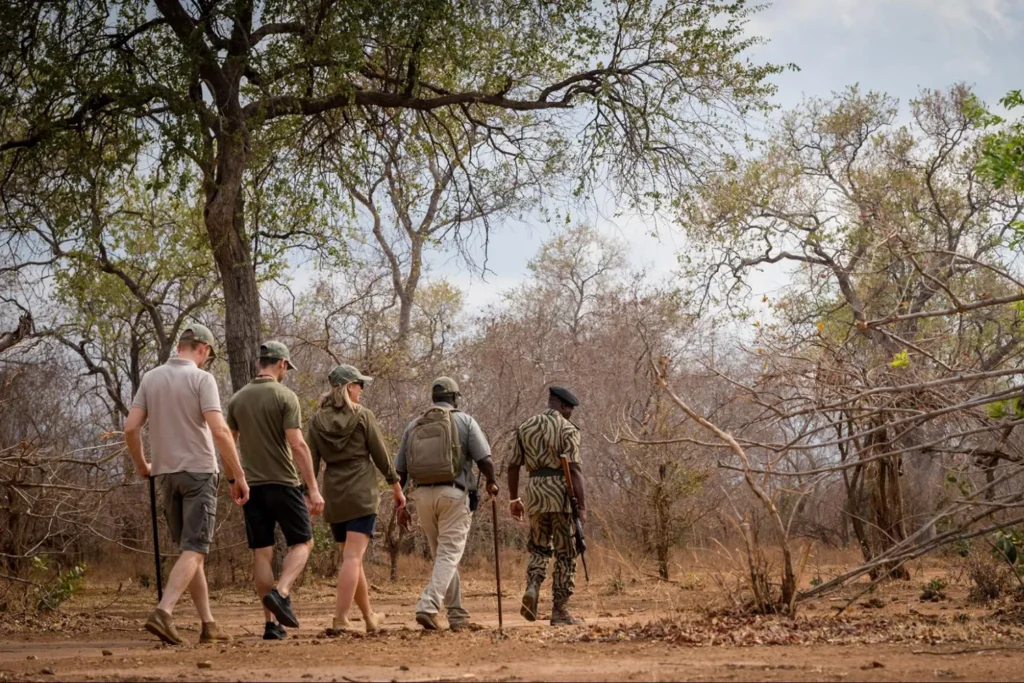
On foot, with an armed guide and a tracker, the scale changes. A scrape on bark where an elephant fed. A seed pod split by a baboon. Guides read the woodland like a morning paper: which trees are fruiting, which have been stripped, where young saplings are fighting their way up through the grass. There is no better way to understand how slowly an African forest grows back.
Boat cruises and canoeing: the river’s green edge
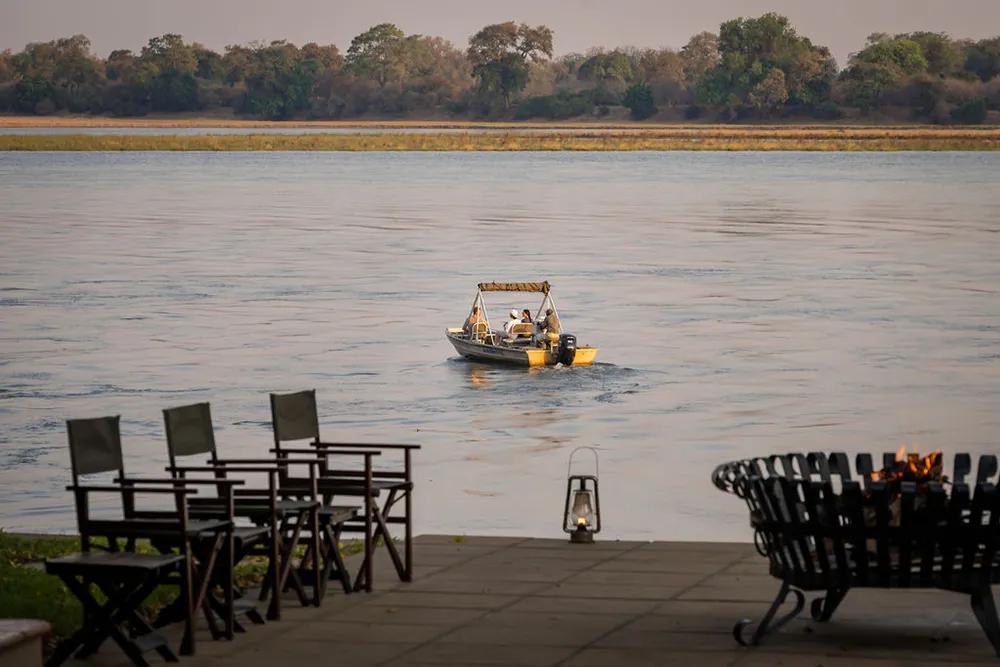
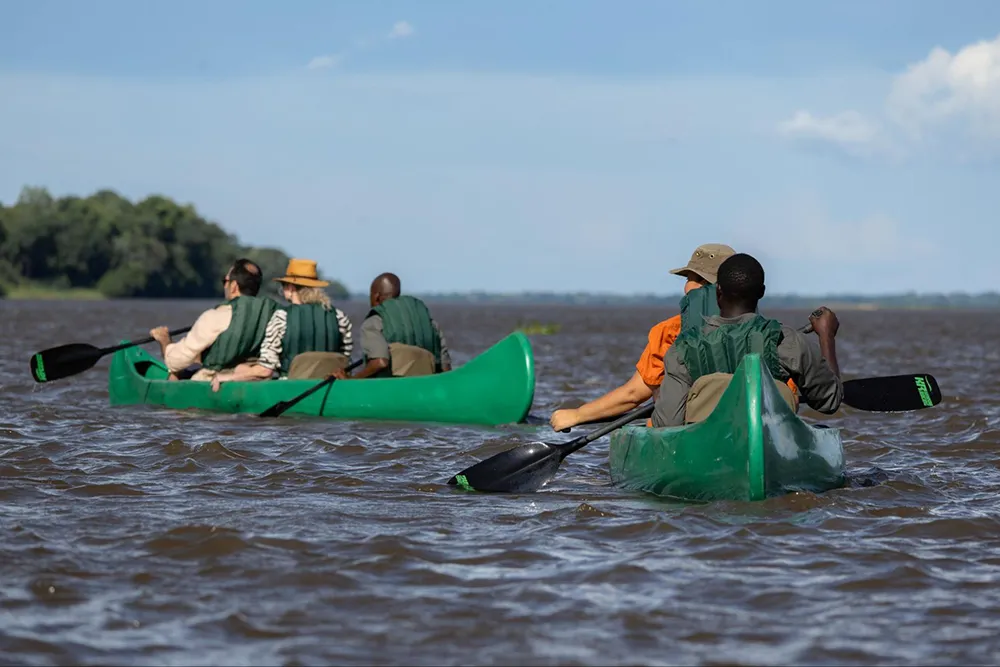
From the water, the riverine forest rises as a wall of green: figs, Natal mahogany and sausage trees leaning over the current. Their roots bind the banks, their crowns carry the nests of Fish eagles, and their shade is where a leopard waits out the afternoon. A canoe lets you drift beneath them in near silence. A sunset cruise ends in front of them, glass in hand, as the light goes copper on the water.
Why does the Lower Zambezi need reforestation?
Beyond the protected areas, the forest is under real pressure. In 2023, 57.6% of Zambian households cooked with charcoal, and that charcoal comes from woodland like this. Zambia lost an estimated 324,000 hectares of natural forest in 2024, and charcoal production alone degrades around 190,000 hectares a year.
Close to camp, the effect is easy to see. Habitat around the Chiawa Game Management Area is shrinking as woodland is cleared for charcoal, and the animals you watch from the vehicle rely on forest that reaches well beyond any park boundary.
This is not a story about blame. Charcoal is fuel and income for families who have few alternatives. Which is why the answer has to be planted with the community, not around it.
How can a safari help the forest?
It starts with where you choose to stay. Baines’ runs on 100% solar power, so no wood or charcoal is burned to keep the lights on. More than 90% of the team comes from the greater Chiawa community, and a farming cooperative supported by the camp is giving local families income from the land rather than from the trees on it. Baines’ is also a Silver Member of Conservation Lower Zambezi, which works alongside Zambia’s Department of National Parks and Wildlife to protect the valley.
Protecting what stands is only half of it. A forest cleared for charcoal takes decades to return on its own, and the valley needs more trees in the ground, planted by the people who live here. That is the next chapter of the story at Baines’, and one we look forward to sharing.
Thomas Baines travelled the Zambezi in the 1850s and 1860s, recording its landscapes in paint. Helping protect the forests he knew feels like the right way to follow in his footsteps.
Plan your time on the river
Choose the activities that suit you, from a sunrise walk to a long afternoon on the water. Your guide will shape the rest, and you will leave knowing the forest a little better than when you arrived.
Read more about sustainability at Baines’
Frequently asked questions
What safari activities are offered at Baines’ River Camp?
Baines’ River Camp offers game drives, walking safaris, boat cruises, canoeing, tiger fishing and fly fishing on the Lower Zambezi. Two guided activities a day are included in the all-inclusive rate. Night drives are not offered.
What is a game drive?
A game drive is a guided wildlife-viewing outing in an open safari vehicle, usually in the early morning and late afternoon when animals are most active. At Baines’, game drives explore the Lower Zambezi floodplain and woodland, often with no other vehicles nearby.
Can you do a walking safari in the Lower Zambezi?
Yes. Walking safaris at Baines’ River Camp are led by an experienced guide with a tracker, focusing on tracks, trees, birds and the smaller details of the bush that are missed from a vehicle.
Why is deforestation a problem in Zambia?
Zambia lost an estimated 324,000 hectares of natural forest in 2024. The main driver is charcoal production, which degrades around 190,000 hectares of forest a year and supplies cooking fuel to more than half of Zambian households.
How does Baines’ River Camp support conservation?
Baines’ River Camp is 100% solar powered, employs a team drawn more than 90% from the greater Chiawa community, supports a local farming cooperative, and is a silver member of Conservation Lower Zambezi, which works with Zambia’s Department of National Parks and Wildlife on wildlife protection and community development.
How can safari travellers help reduce deforestation in Zambia?
Choose lodges that run on renewable energy rather than wood or charcoal, employ and buy locally, and support community livelihoods and conservation organisations in the area. These steps reduce pressure on the forest and give local families alternatives to charcoal production.
